
Behind the Glass
The individual stories behind each component of the mosaic, in the words of the artists.


Ashley: Grizzly Bear & Steelhead Trout
Sofia: Monarch Butterflies


Giovanni: California bush sunflower

Erinn: Prickly Pear Cactus
The Prickly Pear Cactus is a flat padded spiny cactus that grows bright flowers and fruit that is native to California. I chose to commemorate the prickly pear cactus because I view this cactus as a symbol of my culture and as a symbol of the beauty of the land of Los Angeles. Traditionally named “xapa” by the Kumeyaay tribe, its common Spanish name is “nopal”. The Prickly Pear Cactus serves as shelter, food, and more for all living creatures. While the spiky pads protect birds, lizards, insects, and other small mammals from predators, the beautiful pink flowers that sit on the cactus pads hold nectar and pollen essential for bees and butterflies. Native Californian tribes such as Kumeyaay, Luiseño, and Chumash used the flower and fruits as food and the nopal’s juices for medicine and building crafts. The nopal continues to be an essential food in Hispanic cuisine. I vividly remember my mom hand-feeding me delicious pieces of cooked nopales as a toddler, and I cherish that memory. As a photographer, I’ve repeatedly chosen to include cacti in my photographic artwork. My photography emphasizes the beauty of my Mexican culture, and I view cacti included in that beauty. It’s beautiful that plants and animals that are native to the land of LA blend in and continue to thrive in the City of Angels, reminding us every day of the history and nature that came before us.


Maya: Baja California Treefrog

Erika: Cabbage White Butterfly & The Primrose Willow


Nathan: American White Pelican & Kayaker
For my portion of the mosaic I depicted a kayaker rowing along the river and a soaring pelican. I chose a kayaker to represent the recreational value the LA River provides to its neighboring communities. Growing up in Echo Park, I’ve had countless fond memories surrounding the LA River. For example, biking with family up to the LA Zoo and kayaking down towards the 5. By illustrating a kayaker I hope to embody the sense of community the LA River represents. My choice in presenting a pelican reflects a more personal preference as they are one of my favorite birds. Additionally, American White Pelicans are symbolic of the biodiversity in the LA River ecosystem as they are present in migratory stops for feeding.
Juliane: Ladybugs


Elias: California Valley Coyote
I chose the California wild rose (Rosa Californica) as my contribution to the Mosaic. The California wild rose is native to California, Oregon as well as Baja California, and contains deep history tied to various Indigenous uses. The California wild rose, among other native plant species, were seen all along the LA river before the installation of the concrete channel. Even though it’s rare now, you can still see some California wild roses along unpaved sections of the LA river. Because of this, I thought it was important to recognize this plant. Not only does it hold a lot of history but it can be perceived as a form of resistance, making it clear that the river can’t be fully tamed.
Perla: California Wild Rose


Jasmine: California Monkey Flower & Sister Butterfly
Being a big sister is the role I cherish the most. My siblings are pieces that make me whole, and the mosaic was inspired by this truth. I chose to represent the California Sister Butterfly alongside three Sticky Monkey Flowers to represent me and my siblings due to their connection to the ecology of the Los Angeles River. The California Sister Butterfly, like most butterflies, relies on plants along the river to feed. Whereas most butterflies will find the most beautiful flower or fruit to collect nectar from, the California Sister Butterfly has a preference for rotting fruit, reflecting resilience, adaptability and the strength of sisterhood. In addition, the California Sister Butterfly relies heavily on native Oak Trees, which are an extremely important part of Los Angeles’ ecosystem as a shelter and food source. The three Sticky Monkey Flowers are meant to represent my three siblings. The Sticky Monkey Flower is a native riparian plant in the Los Angeles area. It is called “sticky” because it produces a resin to trap moisture, due to growing in drought prone areas, and thus is able to provide for pollinators. Like my siblings, the mere existence of the Sticky Monkey Flower signals resilience, adaptability, and beauty despite facing adversity. Together, these elements symbolize important parts of the LA River ecology and my family’s connection to our home, Los Angeles.
In my mosaic, I created a depiction of an Osprey grabbing a fish out of the water with its razor sharp talons. When kayaking in the LA river, I looked up and saw an Osprey circling near our location. The image of the large wings of a bird of prey soaring 60 feet above me inspired me to reconstruct it in mosaic form. The specific image I constructed depicts the Osprey soaring from out of the water and grabbing a fish. I thought that this would capture the predatory lifestyle of the bird and the balance of the food chain in this eco system. For many years this bird had soared above me as I biked up and down the river countless times. By depicting this in mosaic, I wanted it to represent a connection between the countless species, our natural land, and its intersection with urbanization in North East LA. As I was laying down the many little shards of glass to create the image of an Osprey along the river, I thought about how it would be in a park. How each singular shard comes together to create a powerful image perfectly represents the communal experience of community members coming together in a shared public space. Creating this mosaic gave me a new point of view on our connection with land and ecosystems, and I hope people in the future that experience our mosaic will gain new perspectives as I did.
Oscar: Osprey with fish

.jpeg)
Jackson -matilija poppy
The mosaic to me feels like a manifestation of our values, and of our relationships to lands, waters, plants, animals, and people. I chose a matilija poppy to honor an important mentor of mine, Dr. Theresa Ambo, with one of her favorite flowers from Tovaangar. I am honored to learn from and with her about her Tongva homelands and the people, plants, and animals that shape history, present, and future iterations of Tovaangar. The poppy represents the tangibility of connectedness across places and times, and offers a message of solidarity through connection. Its colors represent the diversity of poppies themselves, and what can happen when we slow down and learn more from our plant neighbors.


Anthony: Ants & Dragonfly
Hayley: California Poppy Flower
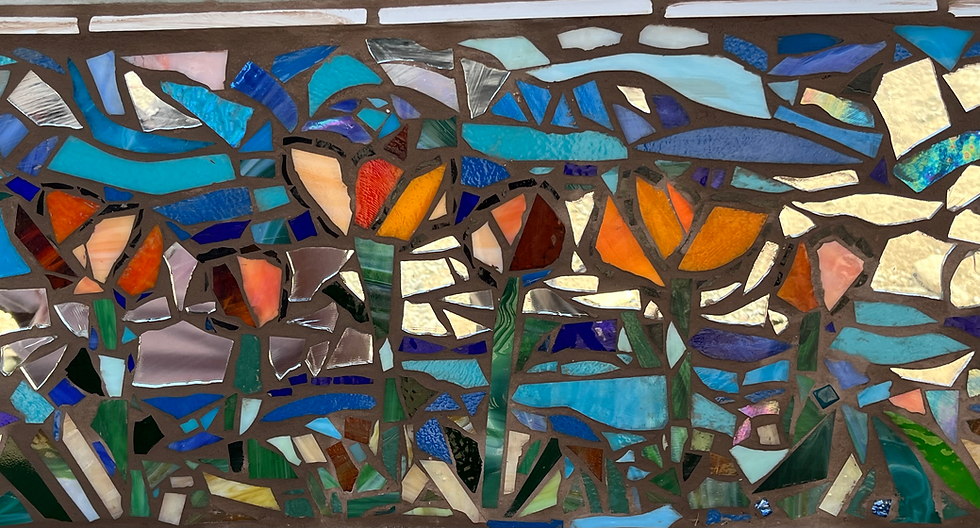
As we began our mosaic, I knew I wanted to include the California Poppy. The poppy is very close to my heart as it represents my journey in becoming an environmentalist. Years ago, I worked on conservation efforts with the LA Zoo and it is there that I found my passion for environmental work. At the entrance to the zoo was the Poppy. As I learned more about California’s flora and fauna, the Poppy stood out to me as I fell more and more in love with it. It was then that I knew I wanted to protect the Poppy, its environment, and all natural spaces of the world. The Poppy is a beautiful and important flower rich in both historical and ecological value. Native to California, the poppy quickly became the official state flower. It's bright gold color represents the Gold Rush history and was known to Spanish explorers as "copa de oro." Beyond its appearance, the poppy sustains over 100 species and is highly drought and erosion resistant. At night, it closes its petals and opens up again with the sun. Years later, the Poppy is a reminder of my passion as I continue to pursue environmentalism, which is why it felt right to put it on the mosaic.

I chose to make a power line for the group mosaic. To me the LA river is a very materially and symbolically rich place. Held within it is histories of interactions between people and the idea of nature that we have constructed around us. These interactions are so often forgotten as we are confronted with a river that has been inexorably altered by human impacts. It becomes easy to forget that the relationship we have now is only representative of one point in a continuous history of our interaction with the river. With the power line I hope to represent the point we live in now. While many lament on what the river is in comparison to what it was or could be, I think it is also essential to appreciate the form the river takes now. I understand the river as a site of resistance and a symbol of alternative ways of life and, to me, it would be another tragedy to ignore that in constant desire for something else. I am not seeking to highlight complacency or say the river need not be changed, instead I want to ask questions about a more just future rooted in the extremely complex and nuanced realities of the past and present.
Evan: Powerline
I chose to portray the leaf of my favorite tree, the western sycamore, because it reminds me of the people and the places I love most. These wide, fuzzy leaves have been a constant in my life, from childhood until now, and the sight of them reminds me of home. Growing up, a massive western sycamore greeted me every morning of preschool at the mouth of Temescal canyon, and my family and I would rest and play in its shade in the afternoons. My grandmother planted several sycamores at her home over 50 years ago, and now they tower over us while we talk and eat to the tune of their rustling leaves. I take great pleasure in pointing out sycamore trees to the students I work with wherever we go, hoping to instill an appreciation for these special beings who provide the shade that allows us to spend the summer outdoors, eating, relaxing, and learning together.
Caroline: Sycamore Leaf
