History & Advocacy

History of the Bowtie
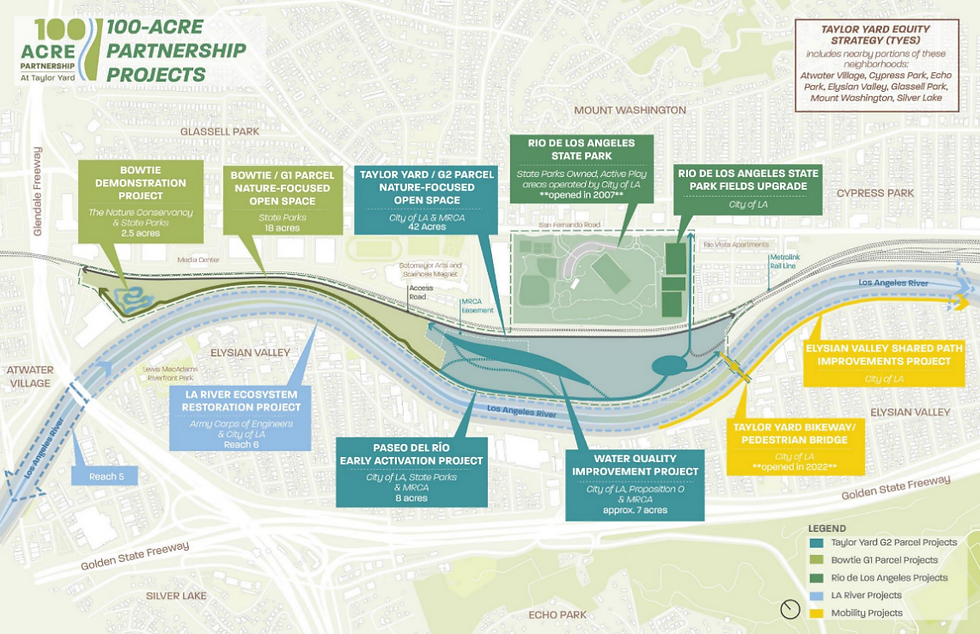
Along the LA river sits 18 acres of undeveloped industrial land that will soon be turned into a vibrant state park. When California State Parks purchased the parcel in 2003, activists along with the community members they represented fought for the revitalization of this land into public green space. In early 2014 the project was officially launched as an art and cultural space. This project helped push forward concrete planning and design for the park. With input from thousands of local activists, artists, and residents, planning for the building of the park was completed and construction began in 2024
The Importance of Parks

Parks play an absolutely vital role to the social and economic health of urban environments, especially in a densely populated city like Los Angeles. By increasing the surrounding biodiversity, parks have great environmental benefits by cleaning the air and water and reducing local temperatures. Parks provide a green public space for the local community that can attract residents and businesses. This communal experience brings people together and increases overall community engagement, which in turn reduces crime in the area. Having a large green space in a major metro area helps the city by increasing revenue and decreasing damage caused by heavy weather. When local communities have access to public land where they can host shared outdoor experiences, they grow in their connection to both local ecologies and to other members of their community.
Health Benefits of Parks
There are many beneficial factors that parks can provide, as they can improve your mental, physical and environmental health. Parks can encourage active lifestyles by providing a space for physical activities and social connections. For many, it can also be a safe space where they can relax and release their stress and anxiety, reducing mental fatigue. Studies show that spending time in natural areas leads to positive long term outcomes, including reducing the risk of numerous respiratory issues, and cardiovascular diseases. Parks can also protect residents from the threat of climate disasters, such as heat waves and other urban health threats, which is something present in our daily lives.
Issues of Green Gentrification
Green spaces have significant importance to communities and neighborhoods, as they provide beneficial factors that improve living qualities for those in these communities, by enhancing physical health, mental well being, and environmental conditions. Green spaces offer communities a space for sports, a place to relax, and a place for new social connections. Because of this, when a new green space is open, it poses a high risk of being affected by green gentrification. Green gentrification is the process of city planners developing new green spaces, such as parks and gardens, with the intention to improve environmental conditions and community aesthetics while benefiting from economic advantages. In the process, planners along with other developers and speculators don’t take the increase in property values that these new green spaces bring into accountability, as they dismiss it from their priorities. This leads to the displacement of low-income communities and neighborhoods surrounding these new green spaces.

Preventing Green Gentrification
While fighting green gentrification is an enormous task, there is one major step to take to ensure no one is fighting it alone. Contributing to Community Land Trusts (CLT) is one way to sustain affordable housing in developing areas. Families facing rising property taxes based on increasing market values may be pressured or forced to sell their homes and relocate. According to a study by the Philadelphia Federal Reserve Bank, the average increase in annual property tax is $1,045 for people in the most extreme areas of gentrification; this forces people who cannot afford the tax bill to face tax foreclosure and sell on the open market to survive.
Here’s where CLTs are able to step in. Once a CLT acquires land they are able to enforce a ground lease, restricting the home resale price. It also forces tax assessors in many jurisdictions to value the property based on its restricted affordable price, effectively resisting the hyperinflation of annual property taxes.
A real world example of this is the Douglass CLT in Washington D.C., a nonprofit organization formed to create economic and racial equity in home ownership and renting. It was created to combat green gentrification and stop displacement in and around the 11th Street Bridge Park project east of the Anacostia River. The Douglass CLT protects homes by acquiring trusts for the land beneath houses, allowing them to take preemptive action in controlling property taxes and resale values.